How to Choose a Watch Strap
Like smartphones, smartwatches have become an integral part of our lives. As well as offering useful features, a watch is also a style statement, so it is worth thinking about which strap to choose. Many smartwatches make it easy to swap straps. Which type do we recommend for a trip to the theatre or for sports? And how can you check whether a strap is compatible with your watch?

Watch Strap Buying Guide: Contents
- Tips for Choosing a Watch Strap
- How to Choose an Apple Watch Strap
- How to Choose a Garmin Watch Strap
- How to Choose a Samsung Watch Strap
- What Types of Watch Strap Attachment Are There?
Tips for Choosing a Watch Strap
- Check compatibility with your watch model. There are still watches on the market whose straps cannot be replaced by the user.
- Think carefully about what you will be using the strap for.
- Do not be afraid to choose a colour that might seem extravagant at first.
- Avoid suspiciously cheap Chinese imitations, which may cause health problems.
Key Factors When Choosing a Watch Strap
Compatibility
This is the most important factor when choosing a new strap. Always choose carefully based on your exact watch model, as not every manufacturer offers a universal solution across all its ranges. There are exceptions, however: for example, Garmin QuickFit straps (20, 22 and 26 mm) can be used with the Xiaomi Mi Band 3/4. Garmin also offers straps with quick-release spring bars (18, 20 and 22 mm) that fit selected Honor, Huawei and Samsung watches.
So how do we recommend checking compatibility? Ideally, you will find everything you need in our description of the strap in question. However, we always recommend checking the details on the websites of both the watch manufacturer and the strap manufacturer. You can read more about the different attachment systems at the end of this article.
Material
Strap Size
Every wrist is different, so straps are usually available in several sizes as part of the accessory range. A reputable manufacturer will make it easy to find out which wrist circumference a particular strap is designed for. You will often see the familiar sizing labels used for clothing: S, M, L and XL.
Watch Strap Fastenings
When choosing a smartwatch, most people focus on the price, brand, features or overall design. Few pay attention to the strap fastening at the time of purchase. This is a shame, because the relatively frequent charging means you will be using it regularly. The fastening also directly affects not only the appearance of the watch, but above all the lifespan of the strap and how comfortable it is to wear.
How Should You Care for Your Strap?
Every strap has a limited lifespan because, although it may not seem obvious, it has to withstand a wide range of extreme conditions. If you wear your watch swimming in the morning and skiing in the afternoon, the temperature change alone will put the strap under strain. Taking care of it will help it last as long as possible.
Wash silicone or nylon straps regularly in soapy water and leave them to air-dry. Never put them in a washing machine or tumble dryer. Do not place a wet strap on a hot radiator either. Metal bracelets tend to be worn on social occasions or at work, so caring for them is straightforward too. Simply clean them at regular intervals, for example with a moist wipe.

What makes the Apple Watch so successful? Its excellent overall features, convenient Apple Pay mobile payments, sports tracking and seamless integration with Apple accessories certainly play a part. In practice, though, many Apple Watch users also appreciate the enormous choice of straps. You get one standard strap when you buy the watch, but that is just the beginning.
Sooner or later, you will want more straps, whether for their looks or their functionality. Apple's original straps can be summed up in one word: varied. There are dozens, perhaps even hundreds, of colour and material combinations to choose from, so there is something for everyone. Another bonus is their compatibility across many years. If you buy a new Apple Watch in two years' time, for example, you can be confident that you will be able to use your existing straps again. That is, of course, unless Apple decides to radically change the design of its watches. But that would work against the company, as such a move would surely be met with considerable resistance even among dedicated Apple fans.
The popularity of the Apple Watch means that there are also plenty of straps from other manufacturers on the market. These are typically cheaper than Apple's own straps, which may appeal to many users.
When choosing a new Apple Watch strap, also bear in mind that there are several sizes. Most straps can be paired with any Apple Watch Series 3 or later case of the same size. Straps for 41 mm cases also fit 38 mm and 40 mm cases, while straps for 45 mm cases also fit 42 mm and 44 mm cases. Things become a little more complicated if you want a Solo Loop or Braided Solo Loop. These can only be paired with the Apple Watch SE and Apple Watch Series 4 or later. Strap sizes 1–9 fit 40 mm and 41 mm cases, while sizes 4–12 fit 44 mm and 45 mm cases.
What Matters When Choosing an Apple Watch Strap?
Choose the Right Strap for the Activity
Using several different straps with your Apple Watch is easy. With a little practice, you can swap a strap in just a few seconds. This lets you replace a premium leather strap with a silicone one in no time when you are heading out to exercise. At bedtime, you can switch to a soft, breathable woven nylon strap that you will barely notice on your wrist.

Garmin smartwatches are excellent companions for sports and leisure. The range includes simple watches with step counters as well as top-of-the-range models with solar charging. Given this variety, it is practically impossible for Garmin watches to use a single strap attachment system. It simply cannot be done.
Garmin currently uses roughly four different strap types. The first is vívofit: you essentially remove the entire display unit from your existing vívofit band and insert it into the newly purchased one.
Next are the QuickFit and QuickRelease strap ranges. These make changing a strap about as easy as on the Apple Watch, which is convenient for the user. However, QuickFit and QuickRelease straps are not compatible with each other. If you replace an older Garmin watch with a new one, you may therefore have to buy your spare straps all over again.
The final type consists of straps with fixed attachments. Unfortunately, these often come with a small screwdriver, as you need to unscrew the old strap and then screw the new one into place. This is not especially practical for matching your strap to an outfit or social occasion. It is more of a solution for replacing a strap that has reached the end of its lifespan.
What Should You Look for When Choosing a Garmin Strap?
Watch Model
Before choosing a replacement Garmin strap based on colour alone, check carefully which model range it is designed for.
Original vs Third-Party Straps
Original Garmin straps are priced at roughly the same level as Apple Watch straps. Expect to pay just over CZK 1,000 for a new silicone strap. If you want a metal bracelet, be prepared to pay several times more.
Third-party straps are noticeably cheaper, but their quality cannot be guaranteed. The selection is also somewhat more limited.

Samsung smartwatches favour the traditional round shape familiar from conventional watches. The range is extensive, with both sporty models and elegant designs that are by no means only suited to women's wrists. Samsung watches run on the company's own operating system, Tizen. Like watchOS or Garmin OS, it is a highly developed system with full Czech language support, contactless payments and its own app store. We should also mention the virtual assistant and the iconic rotating bezel, a distinctive feature of selected Samsung watches. The bezel allows intuitive operation without obscuring the display and makes it easy to interact with the watch when wearing gloves or when your hands are wet or dirty.
All of this makes Samsung smartwatches popular, and they also offer good value for money. However, their generally lower price comes with considerable fragmentation in replacement straps. The vast majority are made for a specific model range. Only occasionally can a strap be used with several similar models, which is a real shame. Samsung should certainly improve in this respect.
What Should You Look for When Choosing a Samsung Strap?
Choosing the Right Version
Of all the brands, Samsung has the least straightforward replacement strap selection. You need to choose a compatible strap based on your exact watch model. You should also expect that, if you buy a different Samsung smartwatch in a year's time, you will not be able to reuse your spare straps.
If you enjoy changing straps frequently, it may be worth looking at the replacement options first and choosing your watch model according to what is available.

Each attachment system differs not only in appearance, but above all in how you attach and remove the strap. However, not every watch manufacturer uses a system of its own. There are a few more universal solutions, each shared by several manufacturers. On a strap's product page at Alza, you can always open the Suitable for section and filter for compatible watches.
Let us look at the different attachment systems and use the illustrations to show how to remove and fit each type of strap.
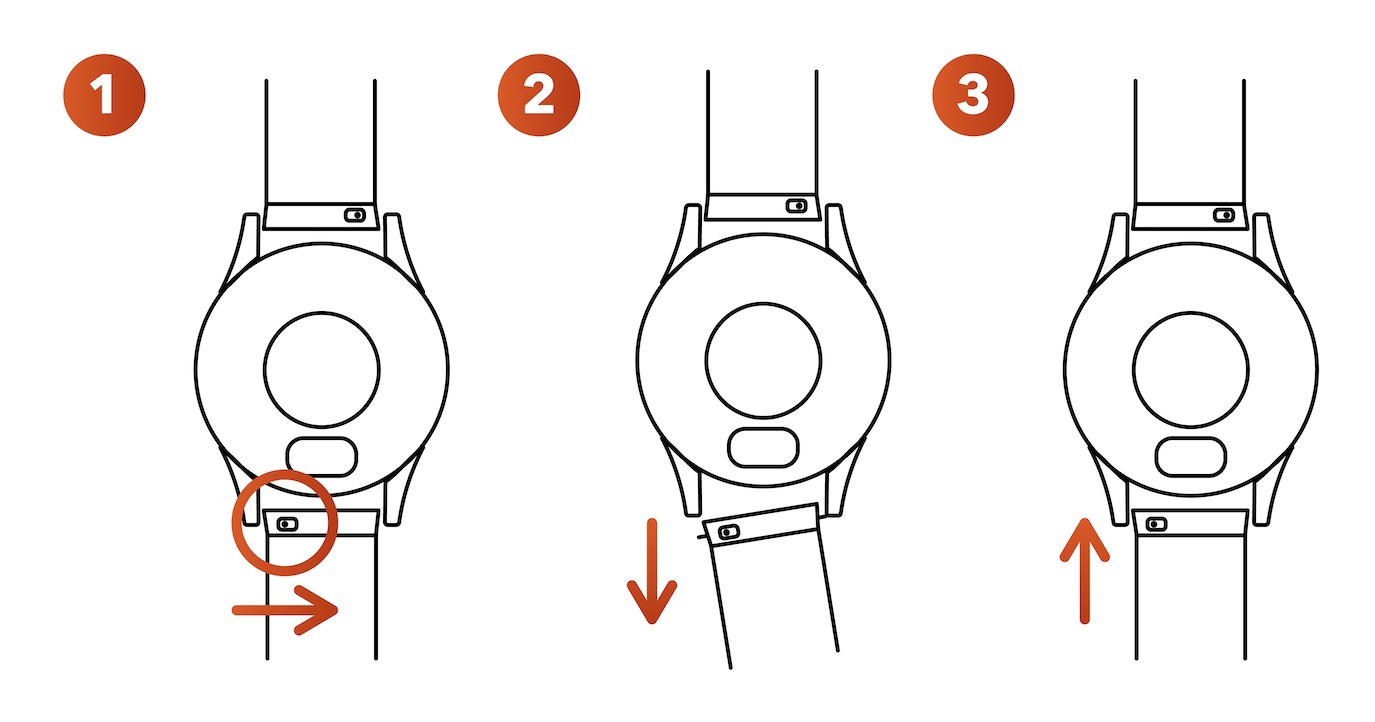
Probably the most widely used universal attachment is Quick Release, shown in the image below. Its popularity is partly down to its long history, and it is often found on conventional watches too. Smartwatch brands that use it include Amazfit, Garmin, Honor, Lamax, Niceboy, Samsung, WowME and others. Attachment widths are usually 16–24 mm. Check your watch's specifications to find out which size you need. To release the strap, simply slide the small lever on the spring bar towards the centre of the strap.
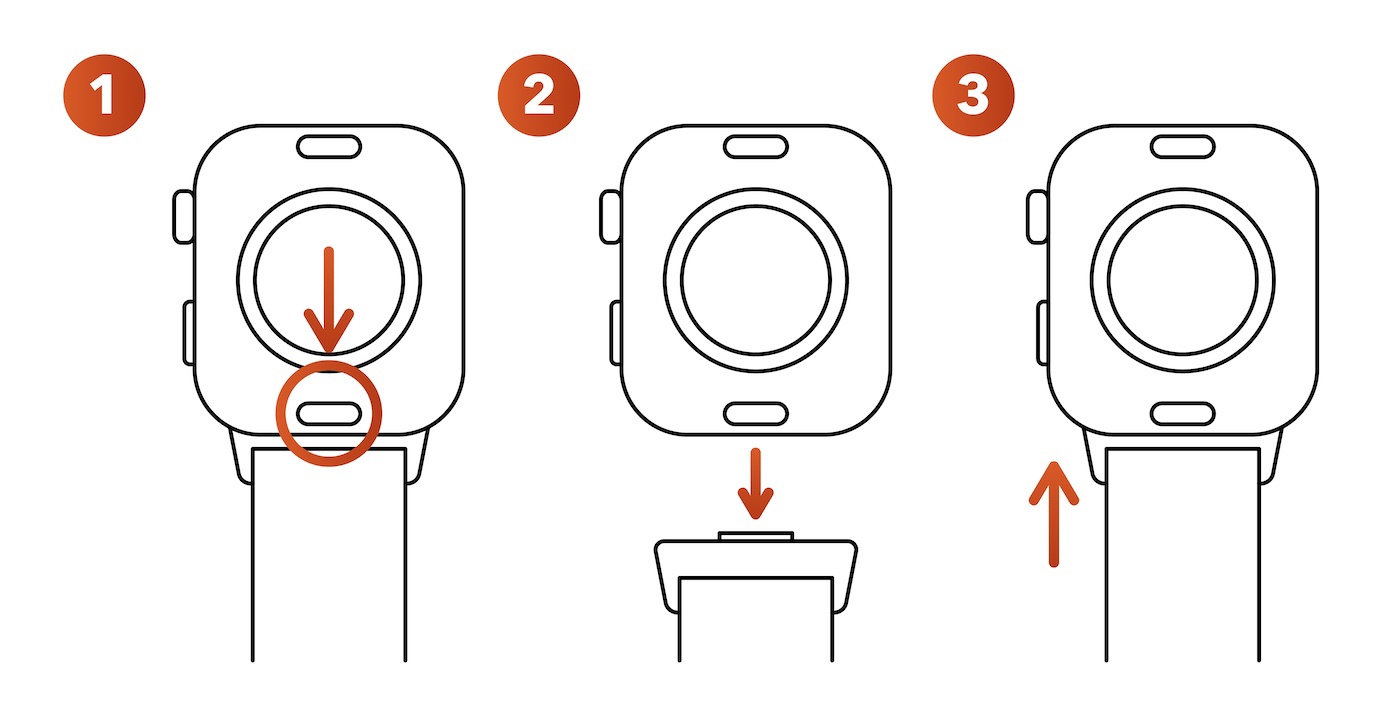
Apple Watch straps stand out because they use an attachment system that you will not find on other smartwatch brands. It uses two release buttons: pressing the relevant button releases the strap in its channel, allowing you to slide it sideways out of the case. There are only two size groups: smaller and larger. The smaller size is intended for Apple Watch models measuring 38, 40, 41 and 42 mm, while the larger size is for 44, 45, 46 and 49 mm models. You can check the size marked on the back of your watch.

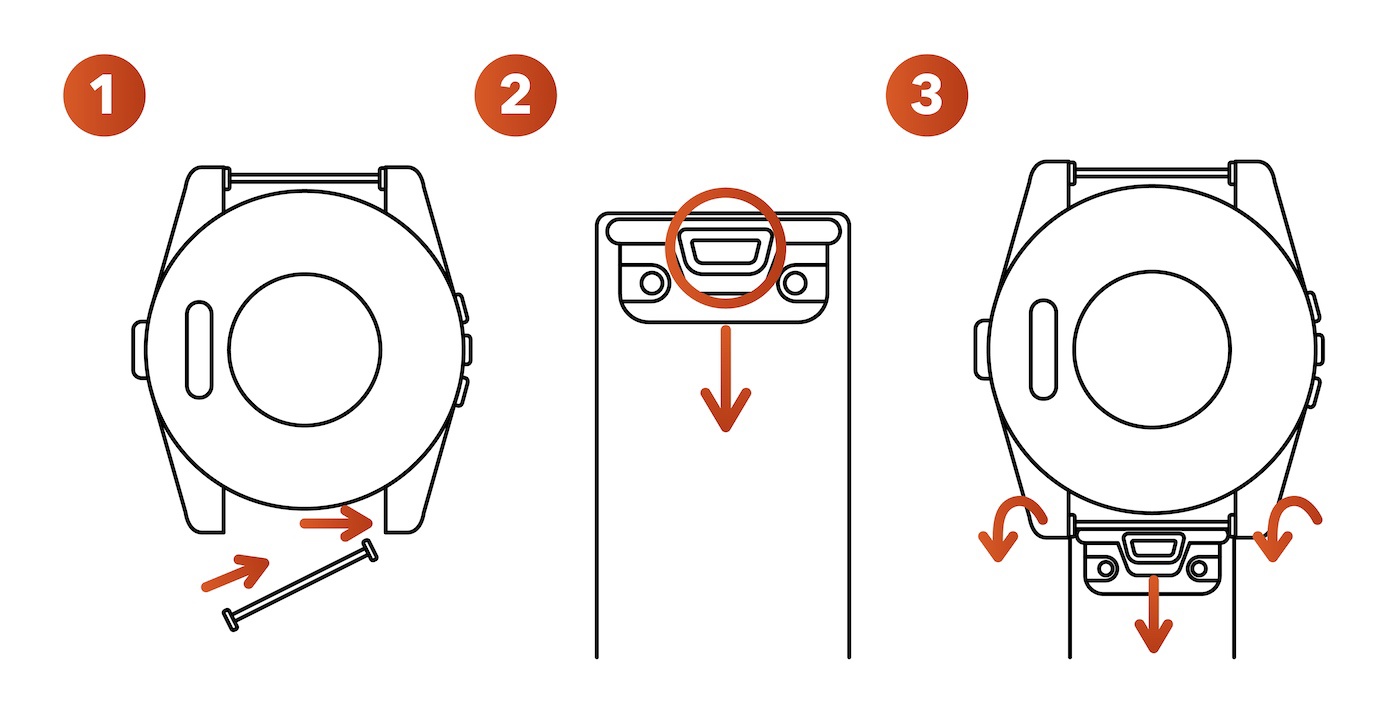
As the name suggests, Garmin QuickFit is used on Garmin smartwatches. The manufacturer does not use it on every model, only on more rugged ranges such as Fenix, Instinct, Epix and Enduro. To fit the strap, pull back its latch, then press the strap into place so that the latch clicks around the watch's bar.
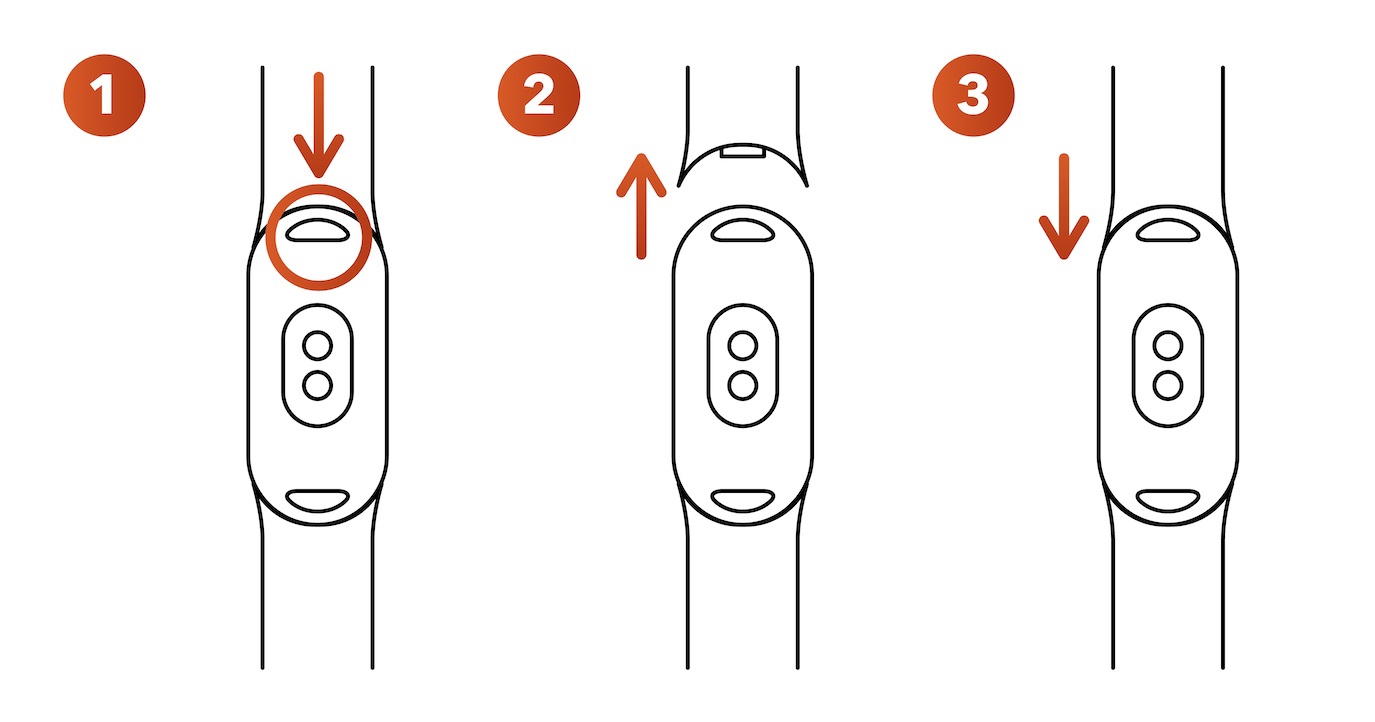
Xiaomi uses a very simple system on its smart bands that is perfectly suited to the slim body of the tracker. Simply press a button, much as you would on an Apple Watch. This time, however, you pull the strap away from the tracker body. To attach it, just click it into place.
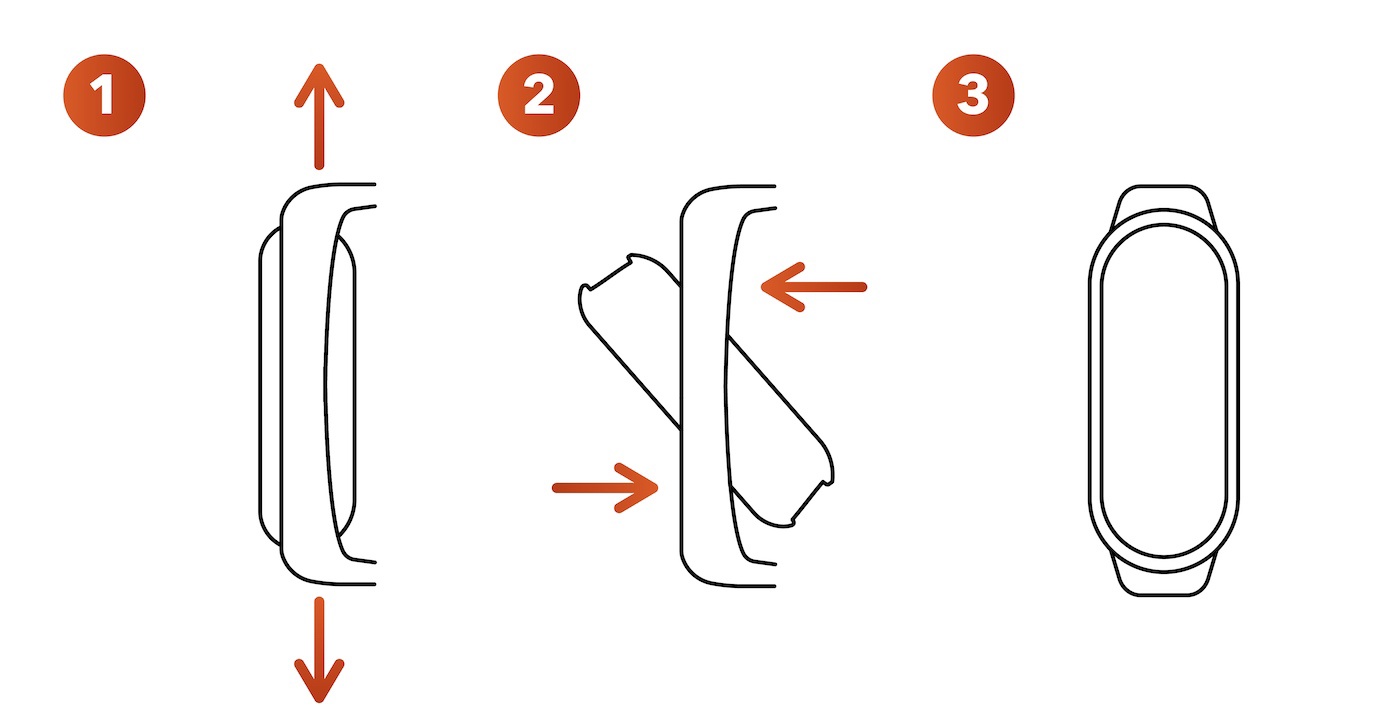
Another strap option for the Xiaomi Mi Band is an elastic band with a specially shaped opening. Simply stretch the opening slightly upwards and out to the sides. You can then easily insert the tracker body into it. This holds it very securely so that it cannot fall out.
Other strap attachment systems are less conventional, although they are often very similar to those already mentioned. You can always find the correct strap type in the specifications of your particular smartwatch.